Documentation Quality Platform For Acute Care

Make every note meet clinical, quality, and revenue cycle requirements.

Working in real time across the whole stay, Sayvant captures the reasoning and complexity of care, checks it against clinical guidelines and the standard of care, and produces notes that are complete, evidence-aligned, and valued for the care delivered.


100+Hospitals
1M+Discharges
$1B+Processed Charges
94.5KLAS Score
SparrowChiMeeWMCHbonsecoursemantetrinityvituitybeaconoaklawnLogoSparrowChiMeeWMCHbonsecoursemantetrinityvituitybeaconoaklawnLogo
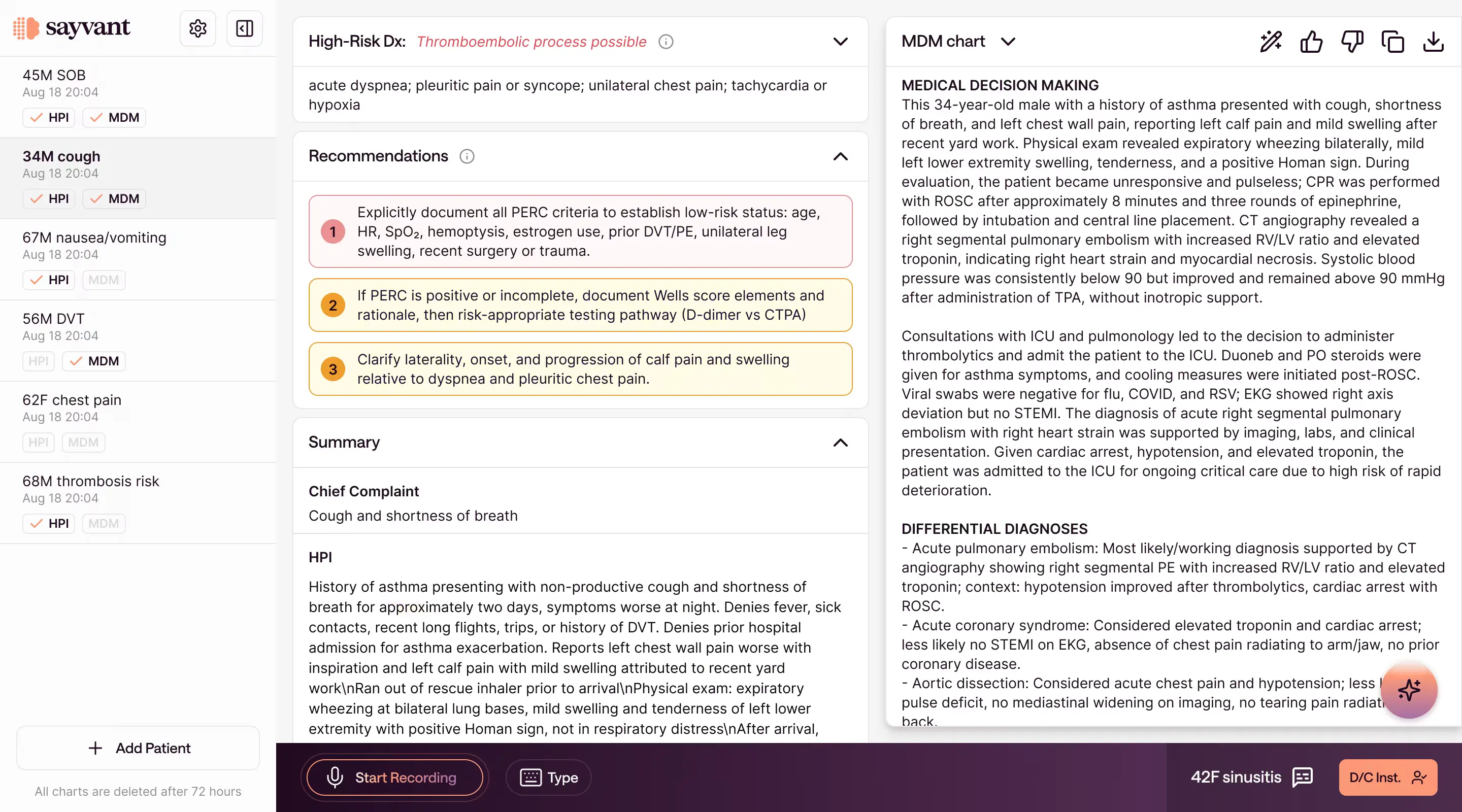
Sayvant platform screenshot
THE PROBLEM

The chart is where clinician pressure and financial pressure meet every day.

The note has to defend decisions that have already been made, while satisfying three readers at once. None reads the chart the way the others do.

Three readers judge every chart.

Clinical

Documentation steals time from patient care, and incomplete notes leave the next clinician without the context to continue it.

Quality and risk

Gaps in documented reasoning make delivered care look subpar in retrospect, when it comes up in peer review or malpractice defense.

Financial

Cases are under-reimbursed because charts don't support the codes the care justifies, and poor defensibility drives denials and rework.

Today's approaches only address one piece each.

Ambient scribe
Drafts the subjective note, doesn't touch the MDM or plan
Clinical decision support
Second-guesses reasoning instead of improving defensibility
UR and CDI review
Reviews a fraction of charts, days after the fact
Revenue cycle team
Fights denials retrospectively, after discharge
EMR templates and education
Spreads slowly and unevenly across clinicians
The Sayvant platform

One documentation quality platform for every chart.

Sayvant satisfies all three readers at once, on every chart. It captures the reasoning as the clinician works, checks it against the standard of care, and makes sure the record reflects the full complexity of what was done before sign off.
ClinicalQualityFinancial
Sayvant note view — the chart reflecting clinical reasoningSayvant recommendations — guideline checks before sign-offSayvant analytics — financial impact of documentation

The thinking behind the care

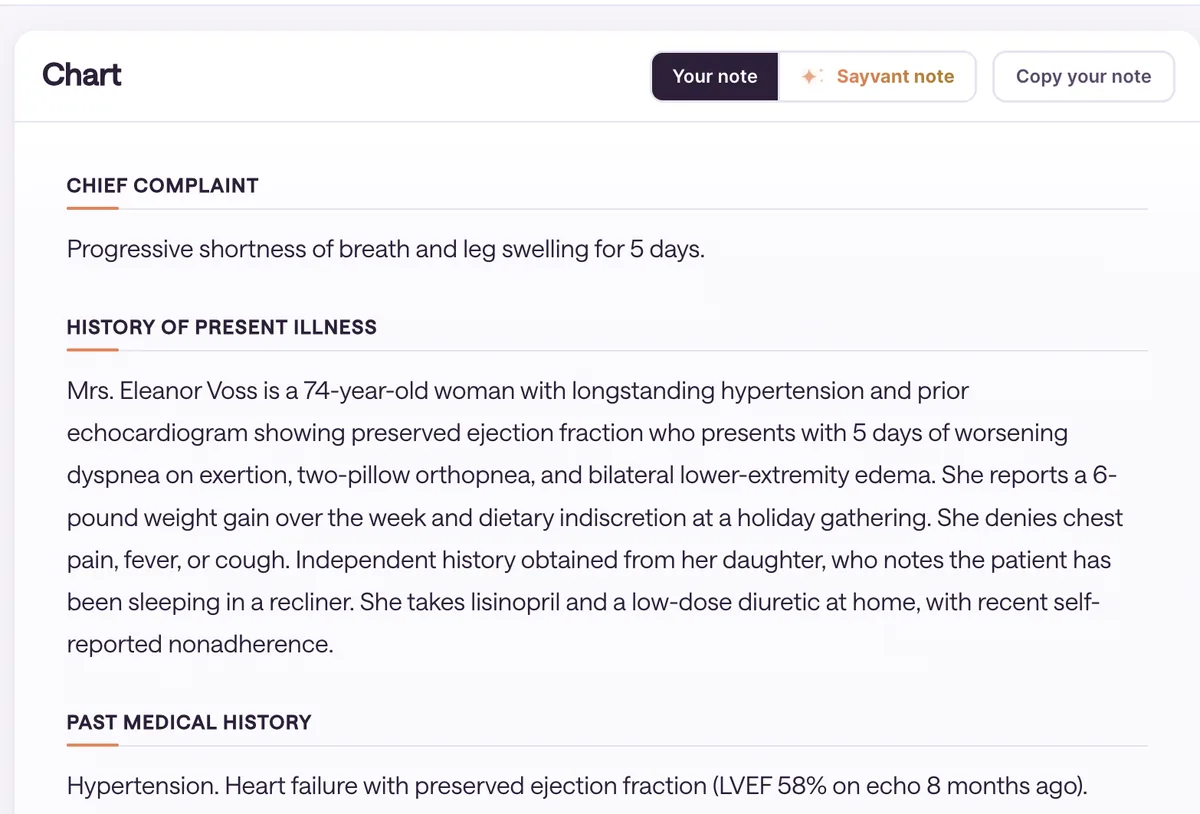
Sayvant note view — the chart reflecting clinical reasoning

Sayvant generates notes that reflect the clinician's actual reasoning and the complexity of the visit, across the whole stay from ED through discharge.

  • Gathers the case from ambient listening, dictation, and EMR data
  • Surfaces high-risk differential diagnoses for consideration
  • Generates full H&Ps, MDMs, and A&Ps
ResultNotes finish on shift, and the next clinician picks up a record they can use.

Aligned with the standard of care

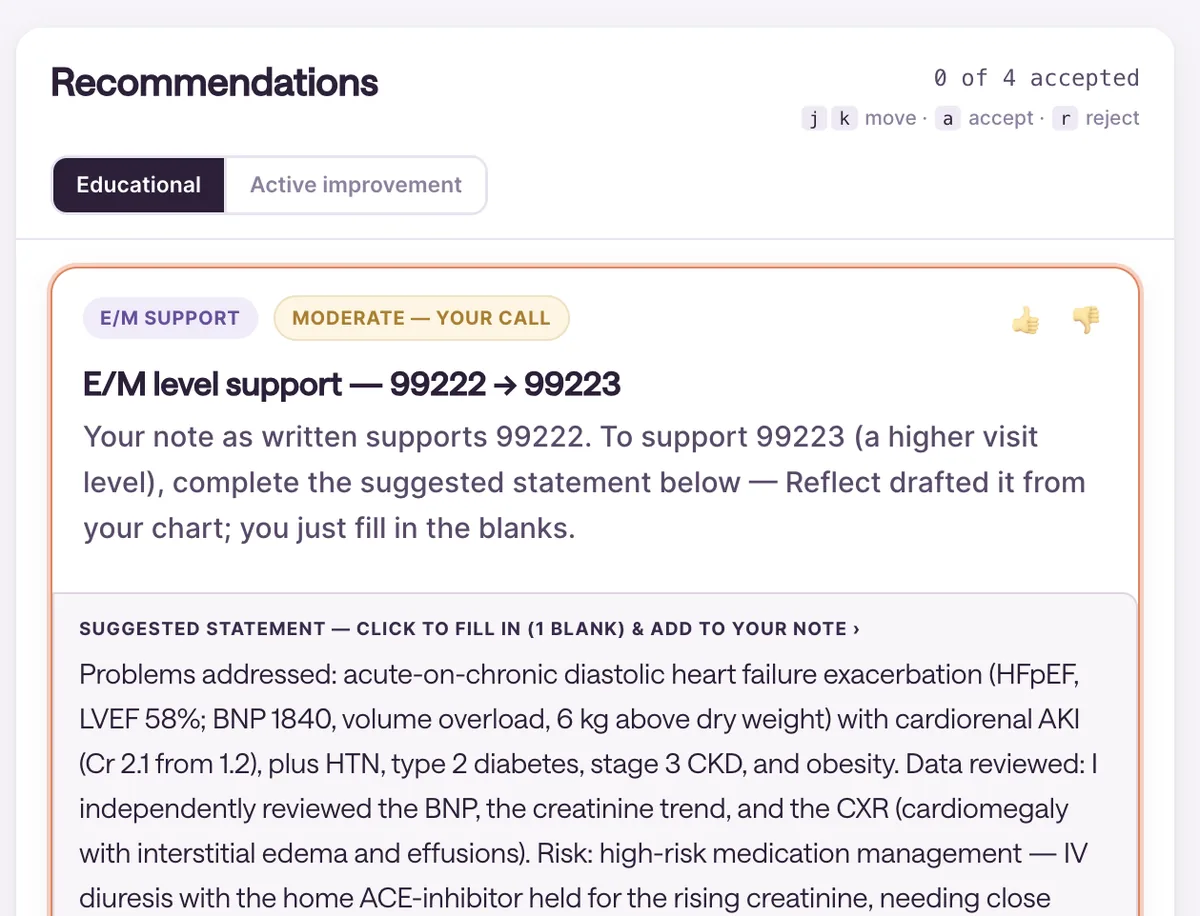
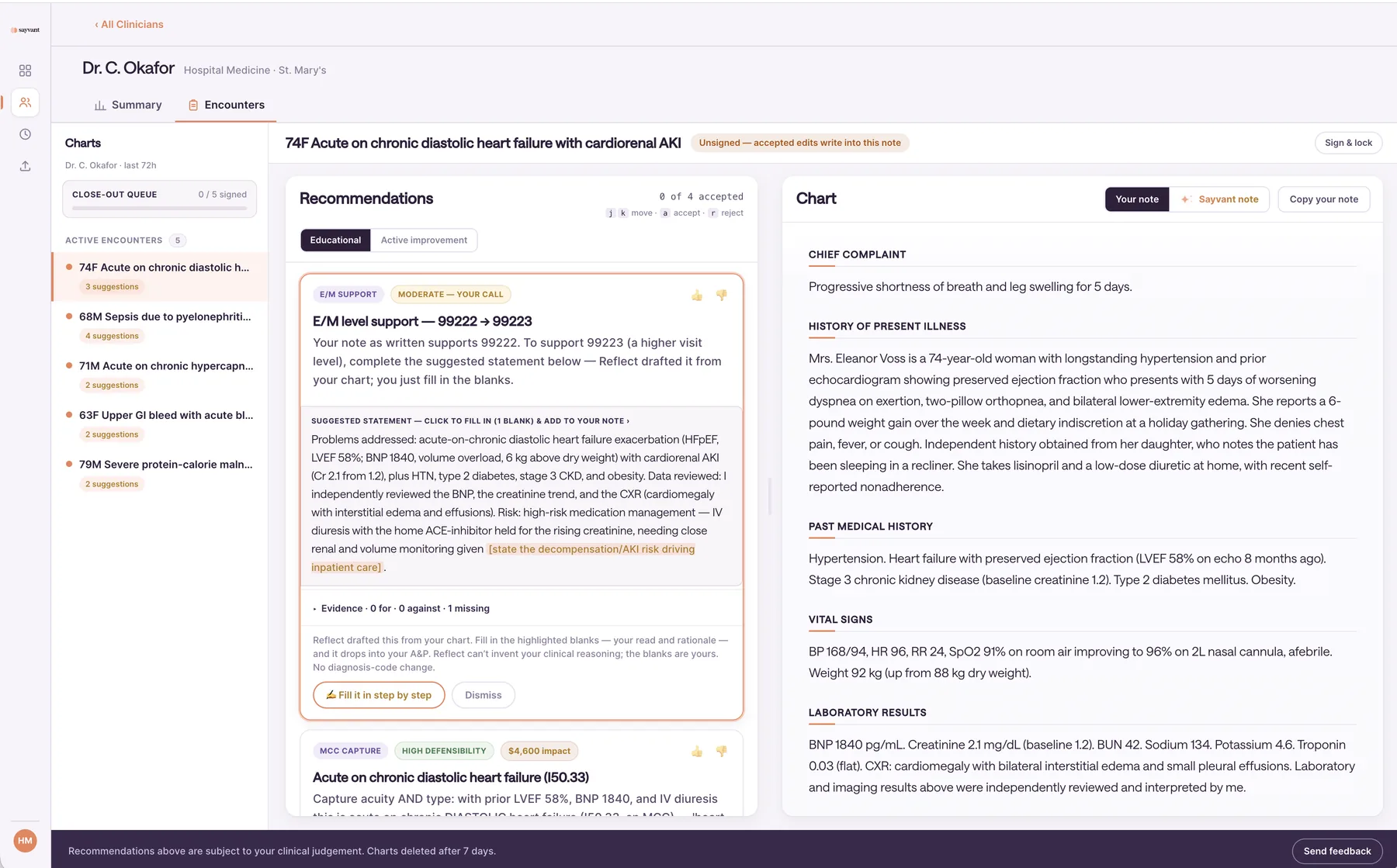
Sayvant recommendations — guideline checks before sign-off

Sayvant checks each diagnosis and plan against clinical evidence and guideline definitions before sign-off, and flags gaps and improvement opportunities.

  • Surfaces next steps and best practices from trusted guidelines like ACEP and BMJ
  • Flags missing pertinent information, from time stamps to interpretations
  • Reviews medical necessity and clinical appropriateness at admission
ResultThe chart holds up to peer review, and documentation varies less from one clinician to the next.

Valued for the care delivered

Sayvant analytics — financial impact of documentation

Sayvant documents the care delivered in line with reimbursement guidelines: medical necessity, diagnosis specificity, and complexity of care.

  • Captures CPT codes for professional fees, including E/M level, critical care, and ACP
  • Suggests DRG bundles based on the chart and clinical plan
  • Reviews medical necessity against system guidelines

ResultCharges and CMI reflect the true complexity, charts drop to bill faster, and CDI queries, denials, and downcoding fall.
For Emergency & Hospital Medicine

Built by acute care physicians.

Most documentation tools are built by people who have never signed a chart. Sayvant was built by acute care physicians. Defensibility, compliance, and clinical standards are built in, not bolted on.

Andrew Napier, MD FAAEM

Co-Founder & Head of Clinical AI

Sayvant Quality System (SQS)

The only per-note quality score in acute care.

Underneath the platform is a physician‑validated scoring system built with an advisory panel of 10 board‑certified emergency physicians.

It grades every note on completeness, clinical quality, and financial defensibility, giving medical directors one number to hold the group to and a clear view of where documentation varies clinician to clinician.

Learn more
Facility + Professional Fee Impact
last 3 months
At riskLostAddressed
$150k
$100k
$50k
$0k
$120k
At risk
$95k
Lost
Apr
$108k
At risk
$82k
Lost
May
$96k
At risk
$68k
Lost
Jun
Opportunities by Category
CriticalMajorMinor
Admission Level
62
Dx Specificity
64
Plan Defensibility
44
E/M & Critical Care
42
Documentation Patterns Analysis
ranked by financial exposure
1
Acute systolic heart failure documented without ejection fraction or chronicity
14 encounters across 5 clinicians · median exposure $4,200/case
Dx specificity
$59k
2
Sepsis admissions lacking source-organ documentation to support an MCC
11 encounters across 4 clinicians · median exposure $4,000/case
Admission level
$44k
3
Pneumonia coded unspecified where organism or aspiration is documented
9 encounters · gram-negative vs aspiration not linked to the code
Dx specificity
$32k
01Fee impact
02Opportunities
03Pattern analysis
Outcomes

Higher quality documentation produces measurable results.

4%
Improvement in professional fee charge capture
3%
Improvement in CMI
5%
Reduction in time to admit
2 hrs
Saved per shift on documentation
TESTIMONIALS

From the clinicians who use Sayvanton every shift.

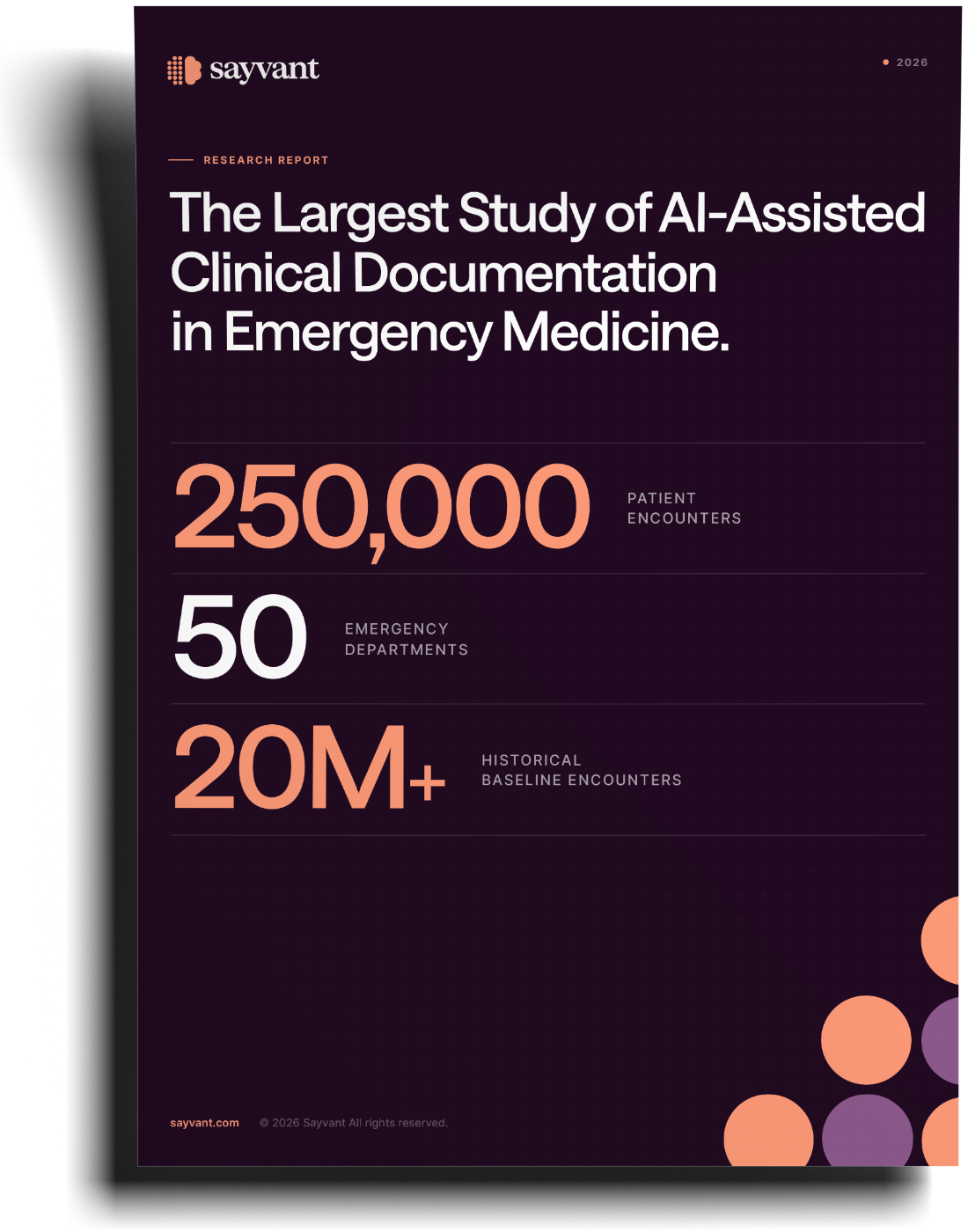
Sayvant 2026 research report cover
New research

The Largest Study of AI-Assisted Clinical Documentation in Emergency Medicine.

Inside the data from 250,000 emergency encounters across 50 departments.

Read the study
Sayvant 2026 research report cover
New research

The Largest Study of AI-Assisted Clinical Documentation in Emergency Medicine.

250K encounters50 EDs20M+ baseline
Read the study